




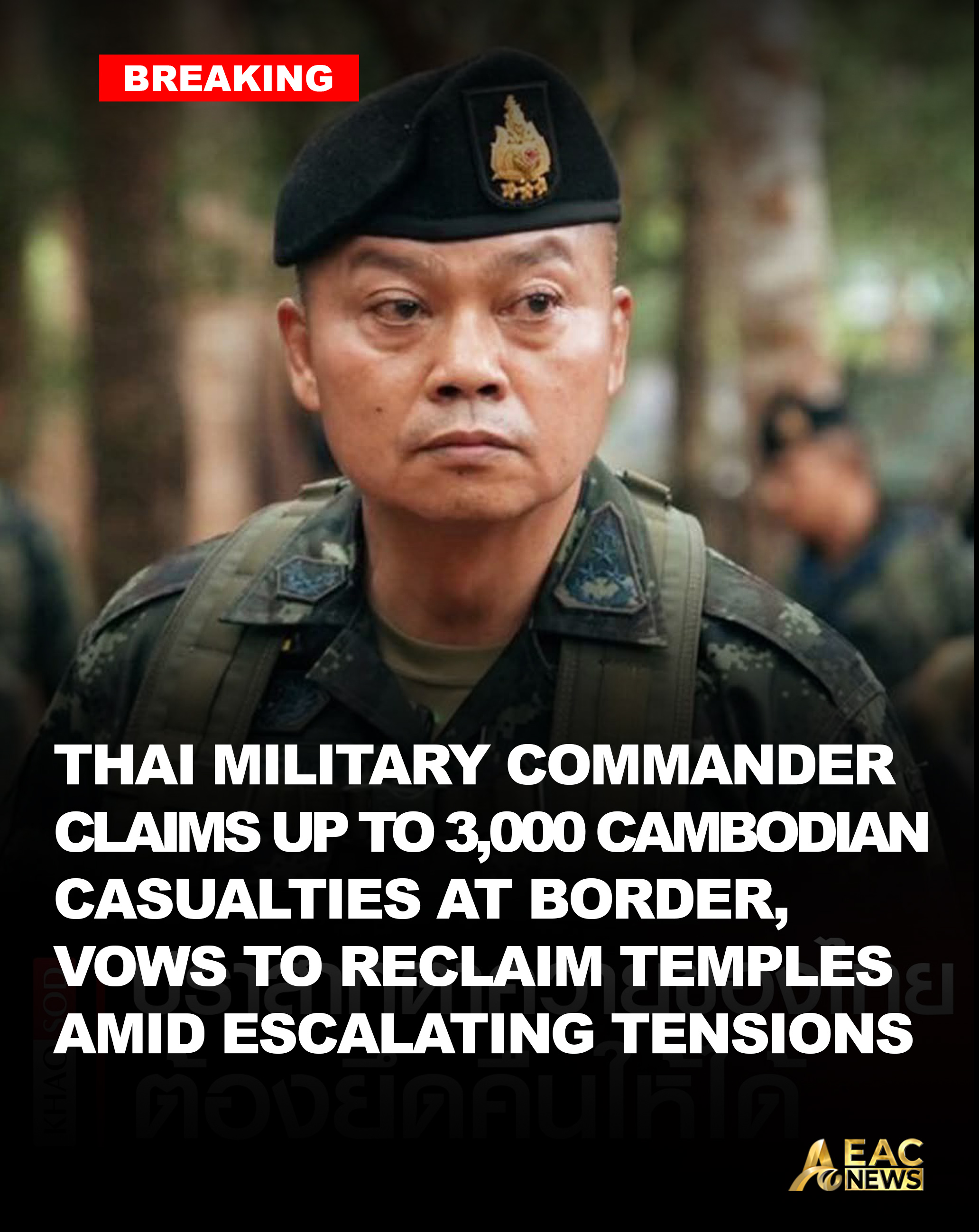
BREAKING: Thai Military Commander Claims Up to 3,000 Cambodian Casualties at Border, Vows to Reclaim Temples Amid Escalating Tensions








PHNOM PENH, August 11, 2025 — Published by Khaosod English on last night August 10, 2025, The commander of Thailand’s Second Army Area has publicly recounted the ongoing conflict along the Thai-Cambodian border, providing a grim estimate of casualties and revealing military intentions amid escalating tensions.
During a statement at Suranaree Camp in Nakhon Ratchasima, Lieutenant General Boonsin Padklang detailed the military situation, suggesting that over 3,000 Cambodian soldiers have been killed during recent hostilities. He expressed a firm stance on reclaiming strategic sites, specifically vowing to regain control of Ta Kwai Temple, which is under Thai occupation, and considering the permanent closure of Ta Muen Thom Temple.
The military leader’s unapologetic declaration comes as border skirmishes and related tensions continue to intensify, raising questions about Thailand’s adherence to the ceasefire agreement reached in late July. Lt. Gen. Boonsin emphasized the need for a stronger military posture, citing the presence of heavily fortified Cambodian military bases near the contested temples. He noted that Thai forces had made multiple attempts to re-enter Ta Kwai but were thwarted by landmines and Cambodian defenses.
In addition to the territorial disputes, Lt. Gen. Boonsin addressed the ongoing issue of drone incursions, stating that numerous drone flights over Thai border areas, including military installations and hospitals, have been monitored and are under investigation. He accused Cambodia of deliberately targeting Thai military and civilian infrastructure, asserting that the Cambodian side is actively seeking the coordinates of strategic locations to potentially launch attacks.
While reaffirming the importance of peace, the commander warned of the potential future needs for underground command centers and reinforced the military’s readiness to reclaim all occupied territory. He also expressed confidence in the morale of Thai troops, noting that injured soldiers are eager to return to the front lines.
The remarks from Lt. Gen. Boonsin mark a departure from diplomatic conventions and underscore the escalating military confrontations in the region. The situation remains tense, with ongoing international calls for restraint and adherence to the ceasefire agreement.
Follow-up: Cambodia’s Response to Landmine Incidents
Following recent incidents involving landmines, the Thai side has accused Cambodia of planting these devices along the border. However, Phnom Penh, on August 9, 2025, issued a firm denial. The Cambodian Mine Action and Victim Assistance Authority (CMAA) stated that Cambodia has neither planted new mines nor intends to do so.
In a statement released by CMAA reiterated that Cambodia is a State Party to the Anti-Personnel Mine Ban Convention, ratified in 1999, and has an internationally recognized record of clearing over one million landmines and nearly three million explosive remnants of war. These efforts have contributed to the protection of civilians and the restoration of safe land across the country.
CMAA also emphasized that no official or transparent investigation has been conducted into the recent incident that injured three Thai soldiers. The authority called on all parties to refrain from unverified accusations that could further undermine the fragile ceasefire and mutual trust.
The Cambodian side urged Thailand to respect agreements made during the recent extraordinary meeting of the Cambodia-Thailand General Border Committee, particularly the clause prohibiting troop movements and patrols beyond designated positions. Cambodia expressed its commitment to working with Thailand, ASEAN, and international partners to maintain peace and stability along the border.
Regional and International Reactions
Thailand’s actions—and the military’s outspoken statements—have drawn scrutiny from regional stakeholders and the international community. Many observers question whether the Thai government’s control over military operations is sufficient to prevent further escalation, especially in the face of provocative declarations like the vow to “reclaim” the temples.
The ongoing landmine incidents and allegations have heightened tensions. Thailand’s Ministry of Foreign Affairs has formally submitted multiple letters under the Anti-Personnel Mine Ban Convention (Ottawa Convention), accusing Cambodia of violations and requesting international intervention. Cambodia’s CMAA responded, denying the allegations and highlighting its compliance with international commitments on mine clearance.
Official Statements and Future Outlook
The Cambodian Ministry of National Defense issued a statement condemning Thailand’s military posture and reiterating Cambodia’s commitment to peaceful resolution and respecting bilateral agreements. Both nations continue to exchange accusations and warnings amid calls for diplomatic restraint.
As international actors and ASEAN member states urge de-escalation, the situation along the border remains fragile. The prospects for a peaceful resolution depend heavily on mutual trust, adherence to agreements, and restrained military actions.
For further updates, stay tuned to our ongoing coverage of the Thai-Cambodian border situation and diplomatic efforts.
Related News